
Guides
twO by Laminam
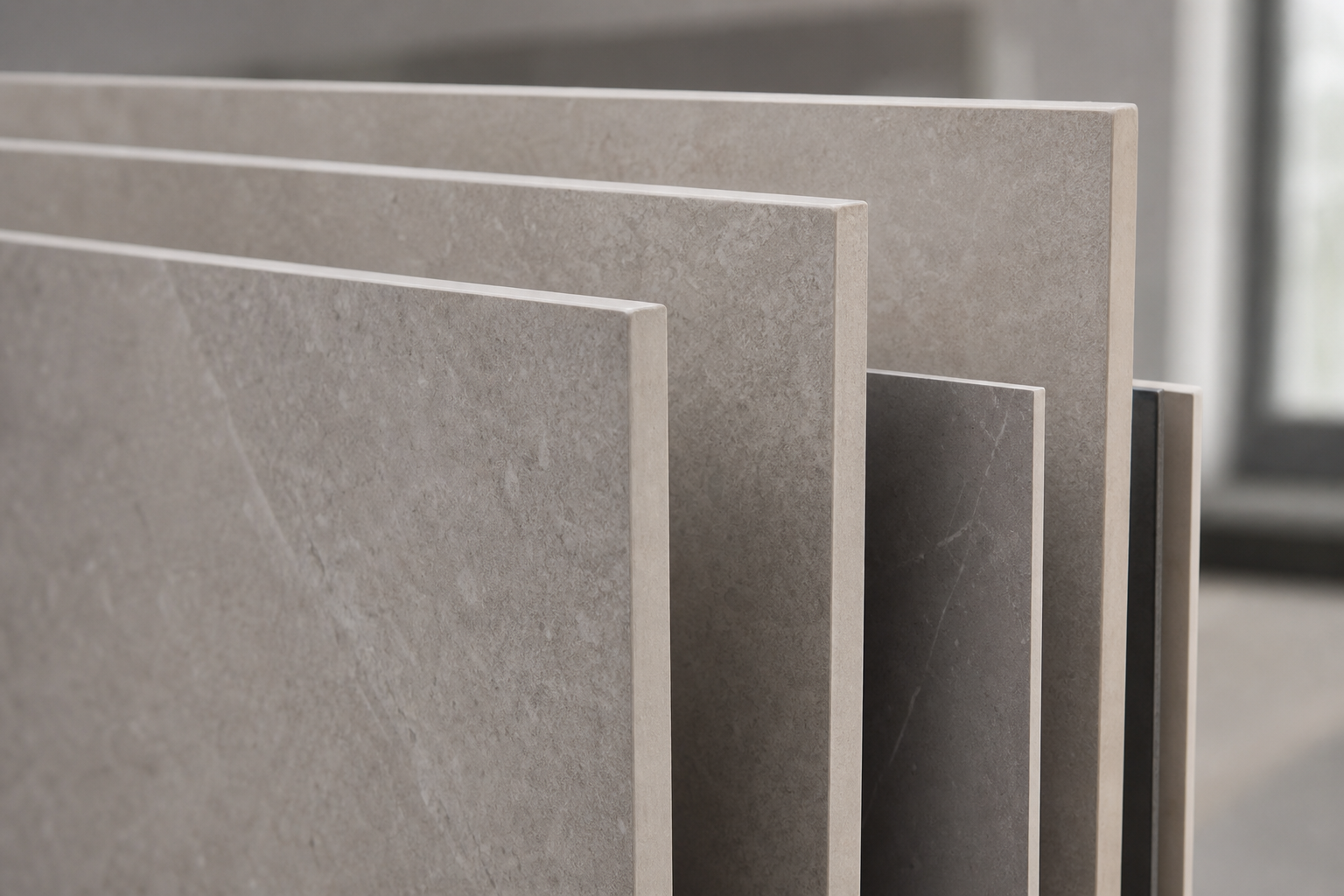
twO by Laminam is a dedicated line of ultra-thin ceramic slabs 2 and 2+ mm thick. They are intended for walls, facades, renovation and furniture cladding, where small thickness and low weight matter.
twO is not a universal Laminam slab. It is not used for worktops or floors. Availability depends on the material and is checked on each material page before ordering.
This guide explains when to consider twO, where it suits, how slabs can be curved and what to align with the workshop before installation.
When should twO be considered at all?
Selection does not start with the material. First you determine the application, then thickness. twO is considered only if the project needs 2 or 2+ mm thickness and the chosen material exists in that thickness.
On the material page, check available thicknesses, finishes and formats. Not every material exists in twO thickness.
If the application requires 12+ mm for a worktop or 5+ mm for a floor, twO is not an appropriate choice regardless of the material look.
Check sequence
- Application (wall, facade, renovation…)
- Whether 2 or 2+ mm suits that application
- Material available in twO thickness
- Finish and format for the project
- Installation plan, including bending if applicable
- Check with the workshop and installer
Laminam 2 and Laminam 2+
twO covers two thicknesses with different structure and application. Check nominal values and format in the manufacturer’s official documentation.
| Label | Thickness | Format | Typical application |
|---|---|---|---|
| Laminam 2 | 2,2 mm | 1000 × 3000 mm | Furniture cladding, interior walls, renovation over existing cladding. |
| Laminam 2+ | 2,6 mm | 1000 × 3000 mm | Interior and exterior walls, facades, furniture cladding, pools (with bonding and material checks). |
Where twO is suitable, and where it is not
Before ordering, check whether twO suits the planned surface:
- Interior wall cladding and renovation over render, plasterboard or existing ceramics.
- Facades and exterior walls, with an appropriate bonding system and a check that the material is suitable outdoors.
- Cladding of fronts, doors and furniture elements, with full structural support.
- Curved surfaces, within the limits defined by the manufacturer and after a feasibility check.
twO is not intended for worktops, kitchen islands, floors or stairs. For those applications use thicknesses of 5+ mm and above, per the Thickness and applications guide.
Bending slabs
One characteristic of twO slabs is the ability to install on concave and convex surfaces, within defined radius and element dimension limits.
That is not an automatic option for every project. Feasibility must be checked with the workshop and installer before ordering, especially if there are cut-outs in a curved area or double curvature on the same slab.
Detailed diagrams, L and H dimensions by curvature type and drawings are in the manufacturer’s official technical guide (PDF below).
Minimum bending radius
Values are from the twO by Laminam technical guide. Final feasibility depends on the element shape, length L, height H and installation method.
| Thickness | Min. radius | Note |
|---|---|---|
| Laminam 2 (2,2 mm) | 3000 mm | Concave and convex. Element dimensions (L, H) must be within the limits in the manufacturer’s guide. |
| Laminam 2+ (2,6 mm) | 4000 mm | Concave and convex. For exterior use, check the material and bonding method. |
| Double curvature | Case-by-case check | The manufacturer does not provide universal tables. The installer must confirm feasibility before fabrication. |
Installation rules on curved surfaces
Before installation on a curved substrate, the workshop and installer should align the following:
- The slab must sit evenly along the full length of the substrate, without pressure at single points.
- For more pronounced bending, a former is used with even pressure across the whole slab, and it may remain as support until the adhesive cures.
- Plan openings in the curved section with a feasibility check. Where possible, drill after installation.
- Handling and installation require experience. The risk of slab breakage during transport and installation is higher than with flat surfaces.
- Substrate shrinkage after installation can cause cracking in curved zones, especially if the slab has cut-outs. Such situations are not material defects.
For details on bonding, external installation and external corners, see the Installation guide and the manufacturer’s PDF documentation.
Handling and fabrication
Transport and storage
twO slabs are lighter than standard thicknesses, but need the same care in vertical handling, edge support and transport on A-frame racks. Packaging is on the manufacturer’s wooden pallets.
Lifting and carrying
Because of the small thickness, two workers, even grip points and avoiding pressure at a single point when lifting are recommended.
Cutting and drilling
Fabrication follows methods approved for Laminam slabs, on a flat, firm support. Low thickness makes cutting easier, but raises the risk of damage if support is poor.
Bonding
Installation with cement adhesives intended for large-format ceramics. The substrate must be flat, stable and prepared before bonding. For external facades, back-buttering is required per the manufacturer’s instructions.
Surface properties
twO slabs retain technical properties typical of Laminam ceramics: resistance to wear, moisture, chemicals, UV radiation and low temperatures. They suit interiors and, with a suitable material and installation system, exteriors.
Maintenance is simple, with warm water and neutral products. For cleaning after installation, see the Maintenance guide.
Manufacturer documentation
- twO by Laminam, technical guide (EN)Format, thicknesses, curving, handling, fabrication, bonding and installation. Primary source for the workshop.Sign in to download PDF
- twO by Laminam, catalogue (IT/EN)Available materials, applications and a visual overview of the twO collection.Sign in to download PDF
FAQ
Bending is a characteristic of the twO line (2 and 2+ mm), within the limits defined by the manufacturer.
Standard thicknesses (5+, 12+, 20+ mm) are not installed on curved surfaces in the same way.
No.
twO is not intended for worktops, kitchen islands or floors. For those applications use thicknesses from the Thickness and applications guide.
No.
twO thicknesses are available only for selected materials. Check on the material page before planning a project around the look.
Feasibility must be checked case by case.
The manufacturer does not provide universal tables for double curvature. The workshop and installer must confirm whether the solution is feasible before ordering.
Not in terms of surface quality.
twO is a different slab category for a different application: ultra-thin, light, suitable for cladding and curved walls, not for loaded horizontal surfaces.
Check materials in twO thickness, then Thickness and applications to compare with other thicknesses.
For fitting and fabrication, see guides Installation and Cutting and fabrication.