
Guides
Maintenance
Laminam is a ceramic surface with near-zero porosity. It does not absorb liquids and does not require impregnation or special protective coatings.
In most cases warm water and a mild neutral detergent are enough for routine maintenance.
Cleaning still depends on the surface finish and type of soiling. This guide explains how to maintain Laminam correctly, what to do after installation and which products to use in different situations.
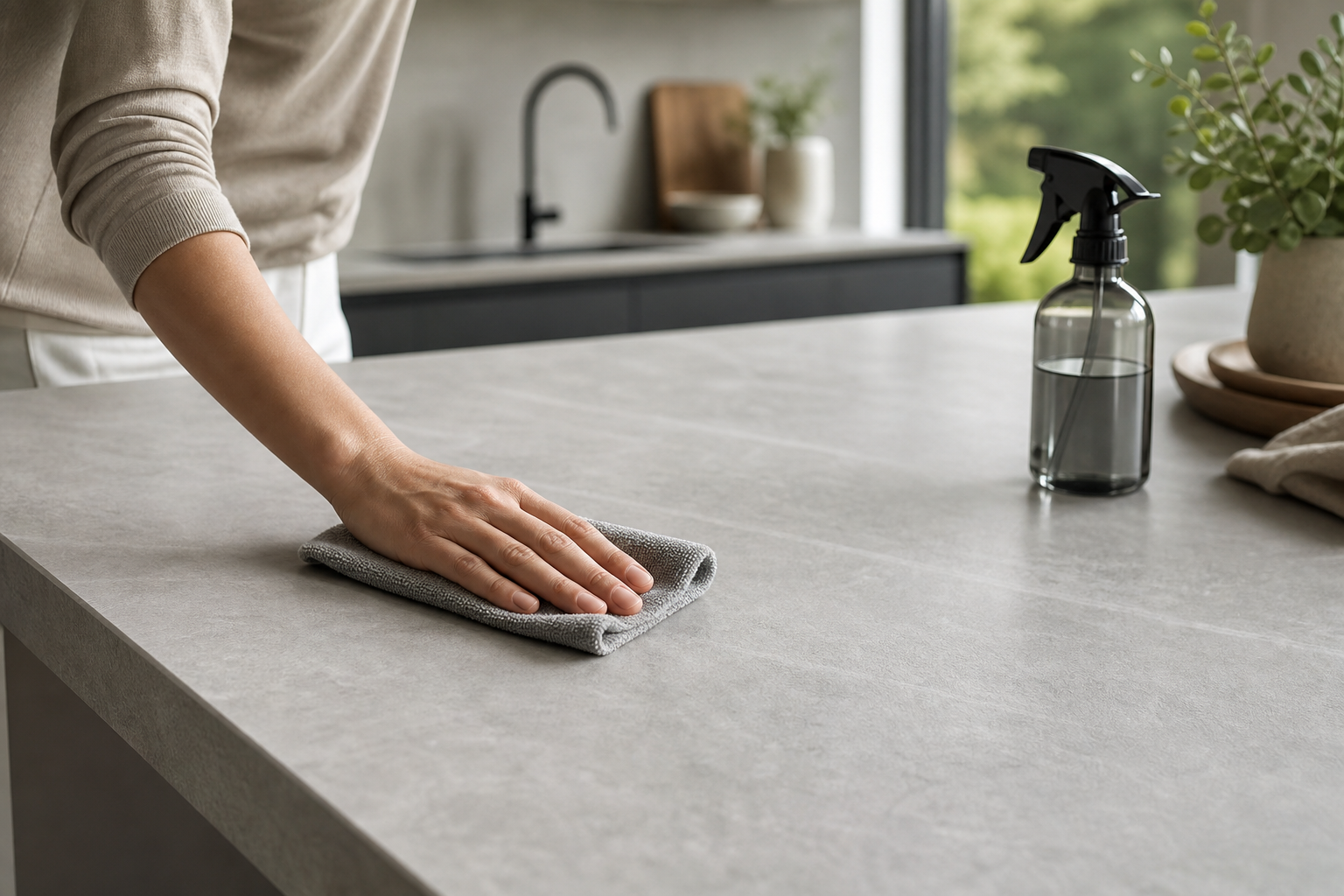
Maintenance starts with correct cleaning
Laminam is intended for long-term everyday use. The surface does not absorb dirt, so most soiling can be removed with simple routine cleaning.
Maintenance is driven by the surface finish, not the material. Before using special products, check which finish the selected material has.
Everyday maintenance
For routine cleaning, warm water and a mild neutral detergent are enough in most cases.
Wipe the surface with a soft microfibre cloth or sponge, then rinse with clean water so detergent residues do not remain.
If Laminam is maintained this way, special cleaning products are usually not required.
Routine cleaning procedure
For everyday maintenance we recommend the following sequence:
- Damp a microfibre cloth with warm water and a mild neutral detergent.
- Clean the surface without strong pressure.
- Rinse with clean water.
- Wipe with a dry cloth to remove water residues.
Routine maintenance this way is enough for most everyday soiling.
First cleaning after installation
First cleaning differs from routine maintenance.
Its purpose is not everyday dirt removal, but residues of silicone, adhesive, cement and construction dust that may remain after installation.
The cleaner is chosen according to the type of residue and the surface finish. That is why it is important to use the right product and follow the recommended contact time.
For facades, the first clean is recommended while surface access is still possible, before works are finished.
Deep cleaning
Deep cleaning is used when routine maintenance is not enough to remove a particular soil.
Before using special products, always test them on a smaller, less visible area.
Choose the cleaner type according to the type of soiling and the material finish. After cleaning, always rinse the surface with clean water.
The earlier soiling is removed, the higher the chance it will come off without marks.
Deep cleaning by finish
Deep cleaning recommendations differ by finish.
For each finish group the manufacturer publishes separate tables with recommended cleaners, sponges and cleaning methods.
Before downloading documentation, check which finish your material has and use the matching manual.
Standard finishes
Natural, Bush Hammered, Flamed, Chiselled, Textured, Raku and most other matte finishes are maintained simply. For deep cleaning, use products recommended in the manufacturer’s official table, with non-abrasive sponges.
Polished and Polished Starlit
Glossy finishes need a more careful choice of cleaners and tools. Abrasive sponges, steel wool and products with abrasive particles that can change the look of the surface are not recommended.
Soft Touch and Caress
Soft finishes have specific recommendations for deep cleaning. Use only products listed in the manufacturer’s official table and avoid products not intended for this finish group.
- Deep cleaning: matt finishes (EN)Natural, Bush Hammered, Flamed, Chiselled, Textured, Rain. Stain, product and sponge table.Sign in to download PDF
- Deep cleaning: glossy finishes (EN)Polished, Polished Starlit. Stain and product table for glossy surfaces.Sign in to download PDF
- Deep cleaning: Soft Touch and Caress (EN)Stain and cleaner table for soft finishes.Sign in to download PDF
Removing different types of soiling
Different types of soiling require different cleaners.
Before using special products, always try cleaning with warm water and a mild neutral detergent. If that is not enough, choose the product by type of soiling and manufacturer recommendations.
The table below is a guideline for choosing a suitable cleaner.
| Remainder | Everyday | If left |
|---|---|---|
| Wine, coffee, tea, milk, juice, ice cream, tomato, balsamic, lemon, beer, jam, nicotine | Warm water and mild detergent | Alkaline cleaner (see the table by finish) |
| Oil, butter, wax, greasy substances | Warm water and mild detergent | Degreaser (see the table by finish) |
| Rust, limescale, metal marks, cement, mortar | Warm water and mild detergent | Acidic cleaner (not on Filo; check the table) |
| Silicone, epoxy adhesive, graffiti, nail polish | Warm water and mild detergent | Solvent or professional product (see table) |
| Residues after installation (cement, silicone, epoxy) | Contact the installation contractor | Per the “Post installation cleaning” table in the PDF |
Facade maintenance
Laminam facades do not require impregnation or additional protective coatings.
In most cases water and a neutral detergent are enough for routine maintenance. Cleaning frequency depends on the environment, air pollution, climate and the position of the building.
For stubborn deposits, the cleaner is chosen by soil type and the facade system manufacturer’s recommendations.
Removing soiling from the facade
On facades you may see residues of construction materials, atmospheric soiling or marks that appear during the life of the building.
Choose the right product by type of soiling, and align application with the facade system manufacturer’s recommendations.
| Remainder | Cleaner |
|---|---|
| Cementitious grout, rust, limescale | Acidic (not on Filo) |
| Epoxy grout, graffiti | Alkaline |
| Silicone, ink | Solvent |
| Pollution, dust | Warm water and neutral detergent |
What should be avoided?
Laminam is a highly durable material, but certain products and procedures can permanently change the appearance of the finish.
- Products that contain hydrofluoric acid (HF).
- Abrasive sponges, steel wool and products with abrasive particles.
- Waxes, protective coatings and products the manufacturer has not recommended.
- Leaving aggressive chemical products on the surface for a long time.
- Dragging heavy or sharp objects directly across the surface.
If you are unsure whether a product is suitable, check the official guidelines first or contact us.
Special notes by application
Basic maintenance rules apply to all Laminam surfaces, but some applications have additional recommendations.
Kitchen worktops
For everyday maintenance, warm water and a mild detergent are enough. When preparing food always use a cutting board, and place hot pans on trivets to protect both the surface and kitchen utensils.
Floors
Clean the surface regularly so fine sand or dust does not stay under footwear and cause unnecessary wear. For washing, use neutral products intended for ceramic surfaces.
Facades
On facades, cleaning frequency depends on the surroundings and exposure. In urban areas or near industrial zones, cleaning may be needed more often than in less polluted locations.
Furniture
For everyday maintenance it is enough to remove dust and wipe the surface with a soft cloth. Abrasive cleaners or rough sponges that can change the look of the finish are not recommended.
Video instructions
If you want to see the maintenance procedure in practice, we recommend the manufacturer’s official video guides.
Video materials show recommended cleaners, cleaning procedures and maintenance of different finishes.
Documentation
For more detail, official Laminam manuals are available.
Documentation covers maintenance of different finishes, facades, worktops and other applications, as well as recommended cleaners and cleaning procedures.
- Cleaning and maintenance guide (EN)Main handbook: handling, worktop installation, after installation, daily cleaning and limits by finish.Sign in to download PDF
- Cleaning and maintaining facades (EN)After installation, routine and deep cleaning, Filo and glossy finishes on the facade.Sign in to download PDF
- Cladding and flooring guide (EN)Supplementary chapters on performance by finish and installation.Sign in to download PDF
- Furniture and design guide (EN)Furniture cladding, tables, doors. Chapter on cleaning and use.Sign in to download PDF
- twO by Laminam, technical guide (EN)Ultra-thin 2 and 2+ slabs: installation, fabrication and maintenance.Sign in to download PDF
FAQ
No.
Laminam has near-zero porosity, so liquids stay on the surface and do not penetrate the material. In most cases it is cleaned with warm water and a mild neutral detergent.
No.
Most finishes are maintained the same way, but some finishes have special recommendations that should be followed to preserve their look.
Special cleaners are used when routine cleaning is not enough to remove a particular soil.
The cleaner is always chosen according to the type of soiling and the surface finish.
Only when provided for in the manufacturer’s recommendations and when they match the type of soiling.
After use, always rinse the surface with clean water.
No.
Unlike some natural materials, Laminam does not require impregnation or protective coatings to keep its properties.
Yes, if used according to the appliance manufacturer’s instructions and suitable for the surface finish.
This page provides official Laminam manuals with detailed maintenance recommendations for different finishes and applications.
Next
Once you understand maintenance, the next step may be exploring materials and finishes, recommended thicknesses by application, and the technical documentation.